
Front cover — 1 de 2
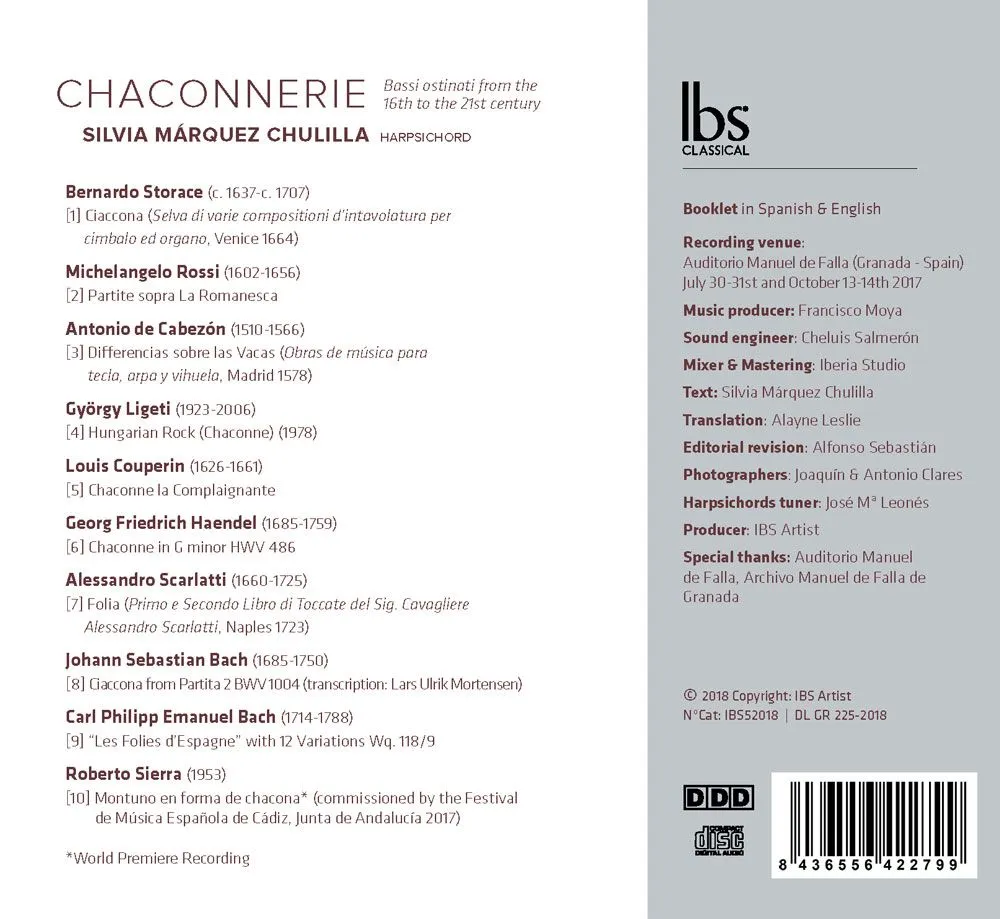
CHACONNERIE
BASSI OSTINATI FROM THE 16TH TO THE 21ST CENTURY
SILVIA MÁRQUEZ CHULILLA, harpsichord
IBS CLASSICAL IBS52018 | DL GR 225-2018
Chaconnerie is an album about repetition. Chaconnerie reveals that principle of Art which seeks to combine elements again and again in order to achieve balance and unity. Chaconnerie invites us on a journey in which sounds – across the centuries – are built on a scheme that is insistently repeated or fancifully varied.
It includes the world premiere recording of Montuno en forma de Chacona by Roberto Sierra, written for Silvia Márquez and nominated for the 2018 Latin Grammy Awards.
Bernardo Storace (c. 1637-c. 1707)
01 Ciaccona (Selva di varie compositioni d'intavolatura per cimbalo ed organo, Venezia 1664)
Michelangelo Rossi (1602-1656)
02 Partite sopra La Romanesca
Antonio de Cabezón (1510-1566)
03 Differencias sobre las Vacas (Obras de música para tecla, arpa y vihuela, Madrid 1578)
György Ligeti (1923-2006)
04 Hungarian Rock (Chaconne) (1978)
Louis Couperin (1626-1661)
05 Chaconne la Complaignante
Georg Friedrich Händel (1685-1759)
06 Chaconne in G minor HWV 486
Alessandro Scarlatti (1660-1725)
07 Folia (Primo e Secondo Libro di Toccate del Sig. Cavagliere Alessandro Scarlatti, Naples 1723)
Johann Sebastian Bach (1685-1750)
08 Ciaccona from Partita 2 BWV 1004 (transcription: Lars Ulrik Mortensen)
Carl Philipp Emanuel Bach (1714-1788)
09 "Les Folies d’Espagne" with 12 Variations Wq. 118/9
Roberto Sierra (1953) *
10 Montuno en forma de chacona (commissioned by the Festival de Música Española de Cádiz, Junta de Andalucía 2017)
Hidden bonus track: Henry Purcell (1659-1695), A new Ground Z.T682 (Musick's Hand-maid II, London 1689)
* World Premiere Recording
“Through the vehicle of a delightful and mature interpretation, this selection of pieces is highly representative of a genre which, like today’s jazz standards, travelled from city to city and permeated every musical milieu. Indeed, this ‘chaconnerie’ is, by definition, obstinate, insistent and energetic, and shows a vibrant creativity in a musical period closer to our own than we might think.”
Pablo F. Cantalapiedra | MELÓMANO
“We have only beautiful words. Her elegance and expressive generosity deserve to be singled out. Her musical vision is an open landscape through which she walks with assurance and nobility to discover beauty, whether in the music of Antonio de Cabezón, György Ligeti or Roberto Sierra.”
Marçal Borotau | SONOGRAMA MAGAZINE
For Rubén
FROM BEYOND THE SEAS TO SOUTHERN EUROPE
I like things to be exactly the same over and over again.
Andy Warhol
Chaconnerie is an album about repetition. Chaconnerie reveals that principle of Art which seeks to combine elements again and again in order to achieve balance and unity. Chaconnerie invites us on a journey in which sounds – across the centuries – are built on a scheme that is insistently repeated or fancifully varied.
Repetition has always flooded humankind’s artistic manifestations and expressions, from the moai of Easter Island to the drawings of M. C. Escher. Repetition is rhythm, pulse, life. And life is what the chaconne oozes – a dance to which Lope de Vega attributes an American origin (“from the Indies to Seville / it has come by post”) and whose character Miguel de Cervantes describes as lascivious and immoral. With an accent on the second beat and variation over a harmonic scheme, this dance bass – together with those of the sarabande, the folia and the passacaglia – encouraged improvisation over chord progressions, a novelty of great impact in the European musical Baroque.
Miguel de Cervantes spent several months in the hospital of Messina (Sicily), the city from which the Christian ships that won the Battle of Lepanto in 1571 had set sail. At the beginning of the 17th century, under Spanish rule, the city reached its greatest splendour, and it was there that Bernardo Storace (c. 1637-c. 1707) was active. We know little else about him. At the other end of the peninsula, in Venice, his Selva di varie compositioni d'intavolatura per cimbalo et organo was published in 1664, a collection of variations on popular dances and melodies together with chaconnes and passacaglias based on the repetition of four bars. Towards the end of the 16th century and the beginning of the 17th, the harmonic formulas that had been used in various Renaissance dances – monica, españoleta, bergamasca, ruggiero, romanesca or folía – were used to compose series of variations.
The transparent simplicity of Storace’s Ciaccona – built on the primitive form of the chaconne bass – contrasts with the abstraction of the brief Partite sopra La Romanesca by Michelangelo Rossi (1602-1656). Born in Genoa and settled in Rome, he was recognised by his contemporaries as an exceptional violinist, but his reputation rests on his keyboard works, in which he explores unsuspected limits with chromaticism. In the Partite he hides the original pattern so thoroughly that the listener really has to strain to recognise the Romanesca bass which, with slight variations, coincides in its melodic-rhythmic formula with the Spanish Guárdame las vacas.
In the service of the most powerful kings, Charles V and Philip II, Antonio de Cabezón (1510-1566) was the most illustrious organist and composer in 16th-century Europe. He cultivated sacred and secular genres; among the latter are “glosas” and “diferencias”, which are nothing other than variations on an ostinato bass and a melody. Such is the case of the Differencias sobre las Vacas, written on a popular romance whose words show that roguery was the order of the day: “Mind my cows for me, my dear, and I shall kiss you; if not, kiss me, and I shall mind them for you.”
BREAKING AND PLAYING WITH TRADITION
I met György Ligeti (1923-2006) at an ambitious festival devoted to him, held in The Hague in 1994. The aim was to study and perform his entire output, and fortunately the harpsichord was not left out. His strong character was nothing but a mirror of the rigour and mastery he brought to his creative field. I was struck by his tremendous admiration for early music and his knowledge of the music of Antonio de Cabezón, Michelangelo Rossi and Girolamo Frescobaldi. He had even experimented with historical temperaments, going so far as to conceive the Passacaglia Ungherese (1978) for a harpsichord tuned in meantone temperament (harsh to today’s ears). Ten years earlier, his Continuum had broken abruptly with everything written for the harpsichord up to that point: the paradoxical creation of an illusion of continuous sound out of the lightning-fast repetition of notes – producing different rhythms and textures at the same time – demonstrates his knowledge of the instrument’s mechanism and a brilliant exploitation of the harpsichord’s resonance beyond the tonal world (even so, veiled references to J. S. Bach’s Clave bien temperado are not lacking).
When approaching Hungarian Rock (Chaconne) (1978), Ligeti acknowledged, alongside the intervals and Balkan rhythms, the influence of the rock of the time and a tribute to the Beatles. On that occasion I did not understand such a connection, beyond the characteristic accents on the last beat of the bar (the crash of the drum kit or the snare roll) which the composer demanded without having written them in the score, since they were “taken for granted” in a rock piece – a chaconne, after all, built on four bars. With the passing of time, the influence of songs from the Beatles’ most psychedelic period seems undeniable to me: the rhythm of “Tomorrow Never Knows” (Revolver) or the special effects of “A day in the life” (Sgt. Pepper’s Lonely Hearts) permeate the scant five minutes of Hungarian Rock.
Curiously, in an interview given to Ulrich Dibelius in 1993, György Ligeti acknowledged that both Hungarian Rock and Passacaglia Ungherese had been conceived as ironic comments on the arguments of his students in Hamburg, and as reactions to the neo-tonal and postmodern movement. The irony, in any case, has left us a key piece of the 20th-century repertoire and an obvious truth: the chaconne tradition is still alive today in jazz, pop and rock.
FROM THE STREET TO THE COURT
Let us turn our gaze for a moment slightly northwards: the key moment in the chaconne’s first transformation came at the beginning of the 17th century in the France of Louis XIV, where it moved from being a social dance to the stage; the chaconne is danced by women while the passacaglia is danced by men (Chorégraphie, ou L'art de décrire la dance, R.-A. Feuillet, 1703). In this way, the primitive binary form began to grow longer (4, 5, 6 or more sections), as in the works of Lully, and shortly afterwards would lead to rondo form (A-B-A-C-A-D-A…). The Chaconne la Complaignante by Louis Couperin (1626-1661) is the perfect illustration of this new genre, and the title itself (“the plaintive one”) suggests a character quite different from the merrymaking aroused by the original dance.
The Bauyn Manuscript shows that Couperin did not organise his harpsichord pieces in a fixed order, but grouped the different types of dance by key. After the preludes, allemandes, courantes, sarabandes… one or several chaconnes would appear. The performer could thus select the pieces in the same key to create a suite of dances to their own taste.
The Chaconne in G minor HWV 486 by Georg Friedrich Händel (1685-1759) has also come down to us as an isolated piece, together with other dances and in various manuscripts in the hands of copyists. These are early pieces, written before his departure for England and probably from his time in Hamburg (1702-1706), when he earned his living partly by giving harpsichord lessons. Hamburg! There he undoubtedly came to know the harpsichords of the renowned local maker Hieronymus Albrecht Hass, a representative of the German school: robust instruments with a powerful sound – far from the brilliance of Italian harpsichords and the delicacy of French ones – and very often with a 16’ bass register whose depth we can appreciate here in the final bars of the Chaconne.
Adopting French nomenclature once again, Handel presents us here with another kind of transformation of the chaconne: the theme-and-variations form, a practice that most probably arose from the musicians themselves in trying to escape the monotony of repeating a four- or eight-bar structure indefinitely.
GREAT VARIATION CYCLES
Thus, instrumental variations on a harmonic scheme or a bass phrase would become one of the greatest expressions of the composers’ creative capacity in the 18th century.
In the universe of the bassi ostinati, only one name could rival the chaconne: the folia, a 15th-century dance originating in Portugal which later moved to Spain. No other name (“madness”) could befit a dance performed to the accompaniment of wild singing while its protagonists seemed to be beside themselves. The term came to designate a harmonic-melodic scheme which has proved to be the most recurrent in the history of music and which reached its height around 1700 with the folias included in Arcangelo Corelli’s Opus V.
The Neapolitan Alessandro Scarlatti (1660-1725) enjoyed great fame as a composer of operas and vocal works. Yet, perhaps encouraged by the success of Corelli and later of Vivaldi’s Op. 1 (1705), in 1710 he wrote a cycle of thirty elaborate variations on the folia – brilliant, lively, virtuosic.
Almost two thousand kilometres away, in chilly Hamburg, Carl Philipp Emanuel Bach (1714-1788) left his post at the Berlin court of Frederick of Prussia in 1768 to succeed his godfather G. Ph. Telemann as Kapellmeister. Carl Philipp had stressed the importance of variation in the preface to his Sechs Sonaten für Clavier mit veränderten Reprisen (Berlin, 1760): “Repeats with variations are indispensable nowadays. Everyone expects them from any performer.”
What perhaps could not be expected was that in those latitudes, and in the last third of the 18th century, the folia would be a theme familiar to the passer-by; it was rather something archaic. The twelve variations on Les Folies d’Espagne Wq. 118/9 blur the dance character to unfold a spectrum of fantasy, virtuosity, contrasting characters – theatrical, I would say – and expressions taken to the extreme.
In any case – what the devil! – abandoning the original spirit was something his father had already done. Nothing is further from lasciviousness, madness and abandon than the Ciaccona from Partita No. 2 BWV 1004 by Johann Sebastian Bach (1685-1750). Composed, it seems, under the grief of the news – on returning from a journey made in 1720 – of the death of his wife Maria Barbara, it has been shown by the musicologist Helga Thoene to conceal throughout a rhetoric of lament and Lutheran chorales, conveying moral and religious messages. “If I were to imagine myself writing or conceiving such a work, I am certain that the extreme excitement and emotional tension would drive me mad,” confessed Johannes Brahms.
Considered one of the most profound works in the history of music, the Ciaccona itself became the object of countless arrangements and transcriptions from the 19th century to the present day: for piano (Busoni, Brahms), organ, cello, guitar, orchestra (Stokowski), and so on. So much has been written on the subject that I would only like to highlight two aspects of the present recording.
On the one hand, I wish to record my admiration for Lars Ulrik Mortensen’s transcription. A harpsichordist and conductor, with a profound knowledge of the instrument, of basso continuo practice and of contrapuntal language, he published this masterly version in 2003 as the epilogue to The Keyboard in Baroque Europe (Cambridge University Press), a collection of essays dedicated to the late maestro Gustav Leonhardt on his 75th birthday.
On the other, the possibility of using a copy of the largest harpsichord known before the 20th century lends the Ciaccona an imposing organ-like dimension. The original harpsichord, built by H. A. Hass in 1740 – with three manuals, five sets of strings (16' 8' 8' 4' 2’), six rows of jacks, and a lute stop and a harp stop for the 16’ – ended up in the hands of the harpsichordist Rafael Puyana. He subsequently commissioned a copy from Robert Goble & Son, an instrument which he donated to the Archivo Manuel de Falla in Granada.
BACK TO THE CARIBBEAN
Let us close the circle: let us cross to the other side of the Atlantic once more. The irruption of the Beatles in the 1960s coincides with the golden age of salsa in Puerto Rico. And if György Ligeti incorporates contemporary music into his creations, so does no less Roberto Sierra (1953), who has always rejected the false division between classical and popular music: “I am Puerto Rican. I am representing our sounds and those of the deep Caribbean.” The link drawn here between Ligeti and Sierra is by no means forced; Sierra acknowledges the former as his great teacher from his studies in Hamburg: “The figure of Ligeti remains in my memory both personally and artistically. He was a friend and mentor, an example of absolute musical integrity and of aspiration to the most refined in terms of technique.”
Through Ligeti, Roberto came to know Elisabeth Chojnacka, for whom he wrote Con Salsa and Concierto Nocturnal (in 2011 I had the honour of taking the leading role in their Spanish premiere, with the Grupo Enigma, at the Auditorio de Zaragoza and the Auditorio Nacional de Madrid). “Her great presence, virtuosity and artistic qualities undoubtedly influenced my approach to the harpsichord.” It is therefore no surprise that he applies his language to the instrument with such mastery in Montuno en forma de chacona. When in 2017 he received the commission from the Festival de Música Española de Cádiz, he did not hesitate to write a montuno, a son of Afro-Cuban origin: “It so happens that the use of ostinati is one of my favourite resources. Having something fixed that does not change allows – and obliges – the imagination to break its chains. In contemporary composition it acts as an anchor, as a substitute for the lack of tonal centres. It also fits perfectly within my Caribbean visions: the obstinate repetitions of the montunos in salsa music are little passacaglias or chaconnes.”
As the fortunate dedicatee, I face the powerful rhythm of the montuno, the technical demands and the expression of madness (a small nod to the folia included) that brings us back to the sensuality of the beginning, to the origin of those dances anchored to the earth, to life and to Nature. Roberto writes vitality, fantasy and madness. Bustle, open air. Caribbean.
EPILOGUE WITH ENGLISH TEA
Could we forget the ground basses and Henry Purcell (1659-1695)? A devotee of variation, he found in the bassi ostinati (grounds in England) the foundation of some of his most beautiful pieces, both instrumental and vocal. One need only recall the overwhelming lament “When I am laid in earth” (“When I lie in the earth”) from the opera Dido y Eneas (1689).
No… let us return to 17th-century Europe; let us compose ourselves, smooth our hair after the Puerto Rican fury, and relax the atmosphere with A new ground, the instrumental version of the aria “Here the deities approve” from the ode Welcome to all the pleasures (Welcome, All the Pleasures).
Kind reader who has come this far, accept my invitation to this fleeting pinch of elegant beauty while we savour – why not? – a good cup of English tea.
Silvia Márquez Chulilla
Here are the reviews of this album (CD).