
Front cover — 1 de 2
TÚMULO CANORO
ON THE TOMBEAU AS ALLEGORY AND LANDSCAPE
PERE ROS & SABINA COLONNA, violas da gamba - EDUARDO EGÜEZ, lute and theorbo | SILVIA MÁRQUEZ CHULILLA, harpsichord
ARSIS 4216 2008 | DL HU 386/2008
This exquisite recording on the Arsis label reflects on a single, invariable space: that of mourning as a visual and sonic landscape.
If baroque composers always sought to assert their will to stir the affections of their listeners, in few genres did they achieve it more effectively than in the lament. It is in the spirit of the tombeau that this album has been conceived, built around works for viol by F. Couperin and by Marin and Roland Marais, and completed by a most beautiful sarabande for harpsichord by William Babell and an allemande for lute by W. J. Lauffensteiner, both likewise identified by the name tombeau.
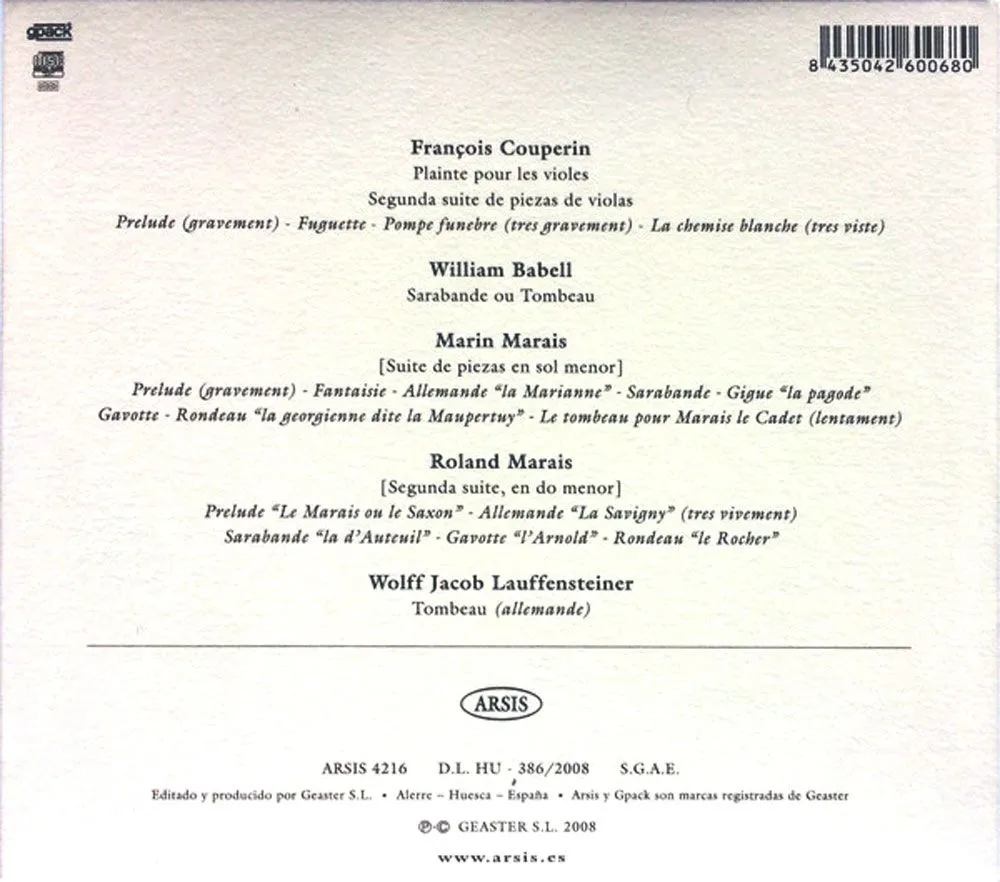
François Couperin (1668-1733)
01. Plainte pour les violes
Second suite of pieces for viols:
02. Prelude (gravement)
03. Fuguette
04. Pompe funebre (tres gravement)
05. La chemise blanche (tres viste)
William Babell (1690-1723):
06. Sarabande ou Tombeau
Marin Marais (1678-1741): Suite in G minor:
07. Prelude
08. Fantaisie
09. Allemande “la Marianne”
10. Sarabande
11. Gigue “la pagode”
12. Gavotte
13. Rondeau “la georgienne dite la Maupertuy”
14. Le tombeau pour Marais le Cadet (lentament)
Roland Marais (1680-1750): Second suite, in C minor:
15. Prelude “Le Marais ou le Saxon”
16. Allemande “La Savigny” (tres vivement)
17. Sarabande “la d’Auteuil”
18. Gavotte “l’Arnold”
19. Rondeau “le Rocher”
Wolff Jacob Lauffensteiner:
20. Tombeau (Allemande):
«One of the great Spanish gamba players, the Barcelona-born Pere Ros, places all his mastery and artistic sensitivity at the service of this delicate music of great expressive power. His interpretation combines the tonal sweetness of his viol with the elegant, solemn breadth of his phrasing and the intense nerve of his details, reaching its expressive peak in the impressive Tombeau pour Marais le Cadet.»
«The superb accompaniment is provided by a luxury line-up: the Italian Sabina Colonna Preti, also a gamba player, the Argentine lutenist Eduardo Egüez and the Aragonese harpsichordist Silvia Márquez.»
Pious zeal today, a cultured
chisel wielded by an elegant artisan,
from expiring marble
gives life to one noble soul and shapes another form,
here where amid jasper and gold
the bridal bed is mute, the tomb melodious.
Luis de Góngora y Argote, on the tomb of Garcilaso de la Vega
On the tombeau as allegory and landscape
Musical space is, without doubt, the opposite of an a priori: the elements that articulate it must, to begin with, be produced in order to be audible, and it takes on form and contours as they appear in the there that they determine, which gives it – as with every work of art – the character of an event.
Three series of heterogeneities constitute the vectors of its spatialisation: one or more series of harmonic relations whose object is this or that simultaneity; one or more series of melodic developments in which what matters, by contrast, is succession; and, lastly, one or more sets of rhythmic patterns that tighten and slacken these series, establishing mobile connections between them.
Such is, broadly speaking, the logic inherent in musical space, whose organisation arouses a certain number of emotional affects that not only fill it but add to it a new dimension in which that space unfolds, a dimension which can and must, nevertheless, be understood as a guide for selecting the logical criteria capable of transforming the passions of the soul – with which the Baroque is always concerned – into a specifically musical piece. And just as it would be insufficient to remain at this last level, affective or moral, disregarding the logical or formal sphere whose elements it informs and amplifies, so it would be absurd to ignore the fact that a second space is thereby added, in the strong sense, to the first. Musical space is, in short, a bifurcated space.
Inseparable from one another, these dimensions nevertheless form a still incomplete whole, for there is a third sphere – or a second unfolding – to be considered here, namely: that of musical space as a body individuated through the combination of certain formal and affective values. We shall call this last – with which we shall be chiefly concerned in these lines – the landscape or physical space of music, which imposes itself on an essentially descriptive gaze without ceasing, in another sense, to be listening. It is, indeed, a landscape that conveys to the listener the affects of the soul transformed at once into sounds and images. This space therefore has an interstitial or borderline quality, ambivalent and hence paradoxical, for we say both that its images can be heard and that its sounds can be represented, each in terms of the other.
The recording these lines accompany has to do, accordingly, with the manifold figurations of a single, invariable space: that of mourning as a visual and sonic landscape capable of adopting plural features by virtue of one and the same rule applied here and there. Be it the descending series of four or more notes, the vibrant repetition of others like a tolling, or their arrangement in the form of waves... All these cases – to which others could, of course, be added – bring out one and the same procedure, consisting in the formulation of a certain analogy: the bowing-down of lament, the funereal toll of a bell, or the swaying of awestruck weeping. And it is in this way that mourning acquires, at once, sound and figure.
Even so, analogy is not merely one more resource within the limits of this space but, strictly speaking, the fundamental law that establishes it and distributes its contents. Now, what exactly is its scope? Let us look closely: it is not a matter of rediscovering, in the depths or on the surface, this or that symbol to which it would refer, thereby linking the particular to the universal, the singular to the generic. What is given here refers to something else only on condition of incorporating it into the theatre of the world: by staging it, it embodies the idea and exposes it to becoming. Analogy thus takes on an allegorical rather than a symbolic sense, just as – let us add – the tombeau does as an art proper to the Baroque.
Each of the motifs mentioned above acts as the axis around which one or more of the pieces gathered on this CD revolve. But not only do these motifs differ from one piece to another; so too does the horizon within whose margins mourning, as landscape, comes to be inscribed, which may be luminous or shadowy, restless or calm. And, consequently, so do the accent and temperament of each work with regard to what it specifically evokes: the memory of the deceased, the expression of grief at their death, or the procession accompanying the dead, for example. But in speaking of the accent of each we might also speak of the kind of stroke to which they respond, as figurations of a given space.
Thus, in his Sarabande ou Tombeau in D major (1702), William Babell gives the evocation, one might say, the form of a serene remembrance: a series of delicate brushstrokes, more courtly than passionate though certainly melancholy, and repetitive, seem to call the absent one to mind. In contrast, Wolff Jacob Lauffensteiner adopts a graver, more solemn tone – elegiac, we might say – in his Tombeau (c. 1710) in C minor, a key which M.-A.J. Mathesson would shortly afterwards underline (cf. his Das Neu-Eroeffnete Orchestre, Hamburg, 1713) as one that "easily induces drowsiness" and which is, in short, suited to expressing "mourning or a sense of lack". The harpsichord and the lute in some way reinforce this opposition: the satiny, ethereal timbre of the former differs from the moist, velvety timbre of the latter.
But absence moves one to tears, and these – needless to say – flow; a flowing that the viola da gamba evokes unsurpassably, being a bowed instrument rather than a plucked one, whose genealogy nonetheless shares some stretches with the lute (it is worth remembering that in Spain it was called the bowed vihuela during the Renaissance). It is precisely the viol that Marin Marais employs in his Tombeau pour Marais le cadet in G minor (c. 1725) and François Couperin in his Plainte pour les violes ou d'autres instruments à l'unisson and in his Pompe funèbre, both in A major.
A new contrast appears here, for whereas in his Plainte pour les violes… Couperin monotonously prolongs the lament, in which several voices take part in unison and which no longer has a narrative character – unlike what we saw earlier – and does so to the beat of the tolling of a "bell" whose sound seems to suspend time at the pace at which the funeral cortège advances or the office of the dead is announced – a unison that at moments gives way to counterpoint, which makes the weeping as natural as it is desolate – Marais presents the lament stirred by the death of one of his children as a reiterated sigh, loving and paternal, which, at times heartbroken – certain strokes of the bow evoke, in their own way, the melismatic style of chant – ends by calming and resigning itself, only to begin anew, like an awestruck breathing. And both works contrast, in turn, with Couperin's own majestic Pompe funèbre (published, curiously, in the year of Marais's death: 1728), which has a more rhetorical and elaborate discursive form, but is equally moving.
This brief survey, of course, is far from claiming to be exhaustive, since it is not the intention of these lines to reduce the works discussed to the aspects mentioned so far, nor to examine one by one all those included on this CD. But if it has served to offer the listener some of the concepts and impressions that emanate from the fascinating aesthetic and musical universe of the tombeaux, it will – let us hope – have been worthwhile.
Carlos A. Segovia
Here are the reviews of this album (CD).