
Front cover — 1 de 2
WEEPING PHILOSOPHERS
LAURENCE ZAZZO
TERCIA REALIDAD, JORGE JIMÉNEZ, SORAYA MAFI | SILVIA MÁRQUEZ, harpsichord
PAN CLASSICS 2024 | PC 10456
The depiction of philosophers and philosophy in early modern music is varied and colourful, at times tragicomic and somehow always "historically informed": the noble but mocked Seneca in Monteverdi's Poppea, the polygamous Socrates in Telemann's Der geduldige Sokrates, the drink-loving Diogenes and Aristotle in the ballads of Leveridge and Lampe, and the lovestruck Heraclitus and Democritus in the more serious duets. There are also the trios and laments of Carissimi, Purcell, Strozzi, Couperin and Jean-Baptiste Stuck.
Heraclitus and Democritus, two pre-Socratic thinkers of the 5th century, were particularly fruitful subjects for depiction because of their association with two opposing effects: Heraclitus came to be known as the "weeping philosopher" and was often contrasted in artistic depictions with Democritus, the "laughing philosopher".
Far from being distant oracles rhetorically dispensing wisdom, these philosopher-singers are feeling as well as thinking subjects, susceptible to suffering and to (self-)mockery in equal measure. In this project, the countertenor Lawrence Zazzo joins forces with the soprano Soraya Mafi and Jorge Jiménez, as well as with the Spanish ensemble Tercia Realidad, to explore, as a form of creative practice, the depiction of philosophers and their philosophies in Italian, German, French and English vocal music of the early modern period.
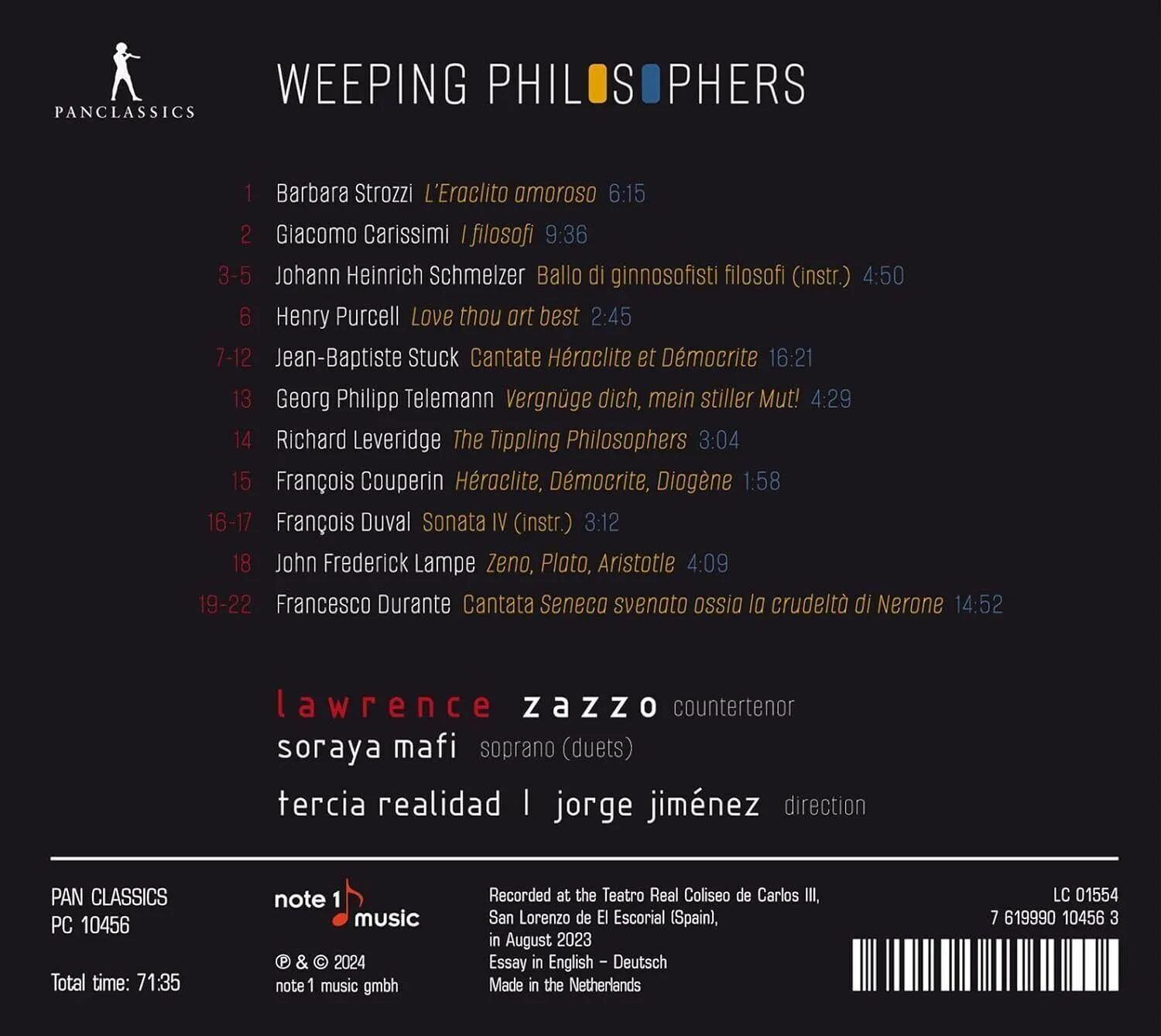
1. Barbara Strozzi: L'Eraclito amoroso (Lawrence Zazzo/Tercia Realidad)
2. Giacomo Carissimi: I filosofi (Soraya Mafi/Lawrence Zazzo/Tercia Realidad)
3. Johann Heinrich Schmelzer: Ballo di ginnosofisti filosofi - Aria 1 (Tercia Realidad)
4. Aria 2 (Tercia Realidad)
5. Aria 3 (Tercia Realidad)
6. Henry Purcell: Love thou art best (Soraya Mafi/Lawrence Zazzo/Tercia Realidad)
7. Jean-Baptiste Stuck: Héraclite et Démocrite I. Dans un abîme affreux (Soraya Mafi/Lawrence Zazzo/Tercia Realidad)
8. Air Héraclite: Pleurez mes yeux (Soraya Mafi/Lawrence Zazzo/Tercia Realidad)
9. Recit Démocrite Laches et credules amants (Soraya Mafi/Lawrence Zazzo/Tercia Realidad)
10. Air Démocrite: Portez a vos belles (Soraya Mafi/Lawrence Zazzo/Tercia Realidad)
11. Recit Héraclite & Démocrite: Non, non (Soraya Mafi/Lawrence Zazzo/Tercia Realidad)
12. Duo Héraclite & Démocrite: Dans la tempête & dans l'orage (Soraya Mafi/Lawrence Zazzo/Tercia Realidad)
13. Georg Philipp Telemann: Der geduldige Sokrates (1721) Vergnüge dich, mein stiller Mut! (Lawrence Zazzo/Tercia Realidad)
14. Richard Leveridge: The Tippling Philosophers (Lawrence Zazzo/Tercia Realidad)
15. François Couperin: Héraclite, Démocrite, Diogène (Soraya Mafi/Lawrence Zazzo/Tercia Realidad)
16. François Duval: Sonata IV (1718) I. L'Héraclite. Lentement (Tercia Realidad)
17. La Démocrite. Tres vitte (Tercia Realidad)
18. John Frederick Lampe I. The Dragon of Wantley (1737) (Lawrence Zazzo/Tercia Realidad)
19. Francesco Durante: Seneca svenato ossia la crudeltà di Nerone. Vincesti pur vincesti (Lawrence Zazzo/Tercia Realidad)
20. Aria: Numi, o voi che in ciel (Lawrence Zazzo/Tercia Realidad)
21. Recitativo: Ma già l'ora fatal (Lawrence Zazzo/Tercia Realidad)
22. Aria: Piangi Roma (Lawrence Zazzo/Tercia Realidad)
"You can’t sing more theatrically than that! Now, one would not do justice to Zazzo’s art if one did not also talk about his technique. Because it is outstanding. He has perfect control of his voice and is thus able to apply all the nuances that his interpretation requires. Tercia Realidad provides stylish playing to accompany the singing."
Remy Franck | PIZZICATO
"The American countertenor Lawrence Zazzo sings a program about crying, in which laughter, as the cover picture shows, is not missing. Zazzo is not only outstanding as a performer, because he is always very close to the text and taps into all possible emotional expressions. Irony and cynicism also come to light in an interpretation that is often caricatured. There is no lack of tenderness, and so Zazzo always succeeds in making the stories told in the program touching."
Remy Franck | PIZZICATO
The depiction of philosophers and philosophy in early modern music is varied and colourful, at times tragicomic and by no means always 'historically informed'.
The noble but mocked Seneca in Monteverdi's Poppea, the hen-pecked, polygamous Socrates in Telemann's Der geduldige Sokrates, the tipple-loving Diogenes and Aristotle in the ballad songs of Leveridge and Lampe, and the lovestruck Heraclitus and Democritus in the more serious duets. There are also the trios and laments of Carissimi, Purcell, Strozzi, Couperin and Jean-Baptise Stuck.
Heraclitus and Democritus, two pre-Socratic 5th century thinkers, were particularly fruitful subjects for depiction due to their association with two polar effects: Heraclitus came to be known as the 'weeping philosopher' and was often contrasted in artistic depictions with Democritus, the 'laughing philosopher'.
Far from being detached oracles rhetorically dispensing wisdom, these philosopher-singers are feeling as well as thinking subjects, subject to suffering and (self) derision in equal measure.
In this project countertenor Lawrence Zazzo collaborates with soprano Soraya Mafi and Jorge Jimenez plus Spanish ensemble Tercia Realidad to explore as a piece of creative practice the depiction of philosophers and their philosophies in Italian, German, French, and English vocal music in the early modern period.
Here are the reviews of this album (CD).