
Front cover — 1 de 2
L. BOCCHERINI
LUIGI BOCCHERINI. CUARTETOS OP. 26
SILVIA MÁRQUEZ CHULILLA & ALFONSO SEBASTIÁN, harpsichords
COLECCIÓN JJMM No. 11 BS 054 2005 | DL M-30197-2005
Despite the rich keyboard environment that surrounded him, Luigi Boccherini paid little attention to the harpsichord. Fortunately, his music was known throughout Europe, and there was no shortage of hands willing to enjoy it on the most common keyboard instruments. Such is the case of the Cuartetos Op. 26, composed in 1778 – in that comfortable position in the service of the Infante which allowed him to devote himself entirely to creative work – and published in Vienna in 1781 by Artaria as Op. 32.
Here is a version for two harpsichords – taken from a manuscript in the Sächsische Landesbibliothek in Dresden – in the hands of the winners of the Concurso de Clave de Juventudes Musicales de España in its 1996 edition.
SOLD OUT
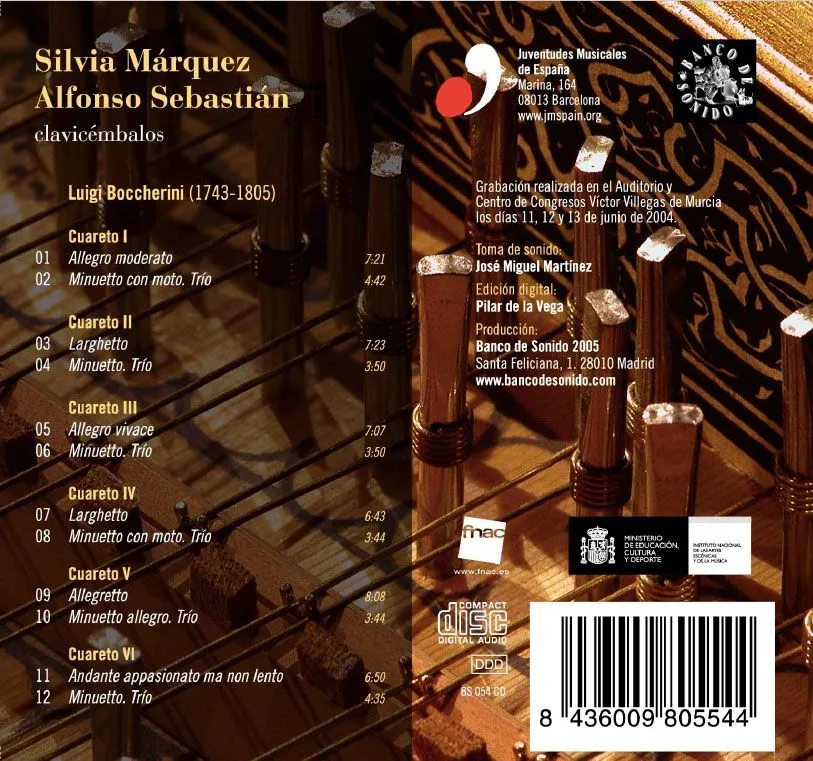
Luigi BOCCHERINI (1743-1805)
Quartet I
01. Allegro moderato
02. Minuetto con moto. Trio
Quartet II
03. Larghetto
04. Minuetto. Trio
Quartet III
05. Allegro vivace
06. Minuetto. Trio
Quartet IV
07. Larghetto
08. Minuetto con moto. Trio
Quartet V
09. Allegretto
10. Minuetto allegro. Trio
Quartet VI
11. Andante appasionato ma non lento
12. Minuetto. Trio
"An intelligent combination for a set of six pieces in which the determination to vary never ceases, intensified by the final minuets which, whether contrasting or not, all show influences of Spanish music: guitar-like writing, dances, harmonies taken from folklore, from the street…"
Silvia Márquez
"Boccherini's chamber music does not admit adjectives such as plaintive, sorrowful, afflicted, heart-rending, painful… It is cheerful, festive, optimistic music, written to the taste of the court and of the Infante Don Luis."
Silvia Márquez
TRANSCRIPTION IN THE 18TH CENTURY
The quartets Op. 26 by L. Boccherini
Well into the 18th century, the rich body of music originally written for two harpsichords or four hands demonstrates the popularity of this practice, to which composers such as F. Couperin, G. le Roux, A. Soler, J. S. Bach, W. F. Bach, J. L. Krebs and J. G. Türk, among others, devoted pages. To this must be added the incessant custom of transcribing pieces for various instruments from their original version to harpsichord or two harpsichords and vice versa: one need only recall the masterly transcriptions for harpsichord that J. S. Bach made of the concertos of Marcello or Vivaldi, C. Ph. E. Bach's own transcription of his Concerto in B flat major for harpsichord and orchestra (Wq. 25) for two harpsichords, and the concerto by J. G. Naumann, «accomodato per due cembali», an Italian term widely accepted in eighteenth-century European music when transcribing quartets or concertos for soloist and orchestra. At the end of Le Rossignol en amour, from the XIV Ordre by François Couperin, the following indication appears: «This piece can be played on different instruments. Even on two harpsichords or spinets, namely the subject with the bass on one, and the same bass with the countersubject on the other; as with the other pieces that may be found in trio form».
Obviously, this whole flow of music between composers, countries and instruments depended on circumstance, on the instruments available and, in many cases, on commercial interests. The fact that in 1784 the Journal de Paris described a four-hand performance by Sejan and Charpentier as «something still very new» is explained quite simply: transcriptions made it possible to enjoy chamber or orchestral music at home, moving from the concert hall to the domestic sphere. For this reason, written references in treatises, the press or encyclopaedias of the time are not abundant, but the practice was widespread: «This Trio, like the Apoteosis de Corelli and the complete book of Trios that I intend to publish next July, can be performed on two harpsichords, as well as on any other instrument. I play them with my family and my pupils, with excellent results (…). It is true that this requires having two copies instead of one, and two harpsichords as well. But I think it is easier to find these two instruments than four professional musicians (…)». (F. Couperin in the preface to the Concert instrumental sous le titre d’Apothéose… de Lully). Publishers knew this, and in the titles of the works they published they offered alternatives so as not to limit sales: oboe/flute or harpsichord/fortepiano appeared interchangeably, they recommended performance on other instruments, or they even ventured to arrange symphonies for small chamber groups, as Salomon did with J. Haydn's London symphonies (which he arranged for trio and later for string quartet with flute and fortepiano).
Quartets and quintets form, precisely, the central core of the output of Luigi Boccherini (1743-1805), a cellist and composer who had already enjoyed success in Milan, Vienna, Rome and Paris by the time he arrived in Spain, and who had formed the first quartet for a paying audience (with works by Haydn, Nardini and himself). In the spring of 1768, following the advice of the Spanish ambassador in Paris, he set out for Madrid, where numerous Italians (Scarlatti, Farinelli, Sachetti, Brunetti, Conforto, Corselli…) were held in excellent regard. He wrote music ceaselessly in the hope of winning the favour of Prince Carlos, but in vain. Finally, a royal decree of 1770 issued in Aranjuez appointed him chamber cellist and composer of music to the Infante Don Luis de Borbón.
He would compose frenetically quintets, quartets, concertos, sonatas… which would open new horizons for instrumental chamber music. It is a pity that Boccherini, although he did arrange his music for instrumental forces different from the original ones, never followed the custom of transcribing it for harpsichord or two harpsichords. In fact, he paid little attention to this instrument, and did not even write a work for solo harpsichord or for organ, a surprising circumstance given the proximity of D. Scarlatti and the important collection of keyboard instruments held by the Court, as well as the fantastic organs within easy reach in enlightened Madrid. Fortunately, his music was known throughout Europe (the Paris publishers promised to make his work famous and succeeded, as well as growing rich at his expense), and there was no shortage of hands willing to enjoy it on the most common keyboard instruments. Such is the case of the Cuartetos Op. 26, composed in 1778, in that comfortable position in the service of the Infante which allowed him to devote himself entirely to creative work, and published in Vienna in 1781 by Artaria, as Op. 32.
Today we present a version for two harpsichords found in a manuscript in the Sächsische Landesbibliothek in Dresden. The date and the author are unknown, but it must undoubtedly have been a very skilled musician or amateur, or a harpsichordist eager to expand the repertoire, since the same hand also produced another transcription of these quartets for harpsichord and strings, and further arrangements for two harpsichords. A faithful portrait of the original Cuartetos, the transcription, in the manner we have seen in F. Couperin's explanations, distributes the parts as follows: cello for the left hand of the first harpsichord and first violin for the right hand; viola for the left hand of the second harpsichord and second violin for the right hand. The only liberties the transcriber allows himself are small variations in the typical cello writing of repeated semiquaver notes, which on the harpsichord become quavers (justified by the homogeneity of timbre of that instrument, which would easily produce too many accents on each of those notes). We, for our part, have added the occasional chord or arpeggio to create crescendo effects that would otherwise be impossible to achieve (following the habitual practice of the harpsichordists of the time, accustomed to using these resources in their basso continuo parts).
In Boccherini's catalogue these Cuartetos Op. 26 appear as «opera piccola», a designation he himself gives to works of small dimensions in two movements, as opposed to «opera grande», of three or four movements. In publishing terms, this distinction also had an economic implication: the former were cheaper.
Restricted to two movements, brevity obliges him to sharpen his wit in order to present varied and contrasting themes in miniature, and he does so within the formal framework of the sonata for the first movements and the minuet for the final movements. As Yves Gérard has pointed out, the achievement lies in presenting in each opening movement of the quartets a different expressive aspect of the sonata: No. 1, a certain Italian style of writing; No. 2, the pre-classical style; No. 3, more brilliant and symphonic, and in E flat major (Boccherini's favourite key), contrasts with the repetitive grace of the Larghetto of No. 4; No. 5 is the one that comes closest to classical sonata form; and in No. 6 Boccherini's «romantic vein» emerges.
An intelligent combination for a set of 6 pieces in which the determination to vary never ceases, intensified by the final minuets which, whether contrasting or not, all show influences of Spanish music: guitar-like writing (No. 2), dances, harmonies taken from folklore (No. 6), from the street…
It was by no means a new language for him: he had already introduced into earlier works dances such as the fandango or popular themes such as the folía. Boccherini's chamber music does not admit adjectives such as plaintive, sorrowful, afflicted, heart-rending, painful… It is cheerful, festive, optimistic music, written to the taste of the Court and of the Infante Don Luis, from a comfortable situation, in fertile and happy years, and free of obligations. Boccherini, now definitively settled in Spain, works here without losing contact with the outside world, where his works circulated in manuscript or published by the best publishers of the day. It is therefore no surprise that in 1785 Crown Prince Guillermo Federico of Prussia appointed him his chamber composer. Nor was he unaware of the novelties of European composers. If he did not follow the prevailing trends, it was because he did not wish to: because he remained faithful to his own style and spirit.
Paradoxically, Italy had given us the «most Spanish» composer of eighteenth-century European chamber music.
Silvia Márquez Chulilla
Here are the reviews of this album (CD).