
Front cover — 1 de 2
MON DIEU, PRÊTE-MOI L'OREILLE
MÚSICAS DEL SIGLO XVII FRANCÉS
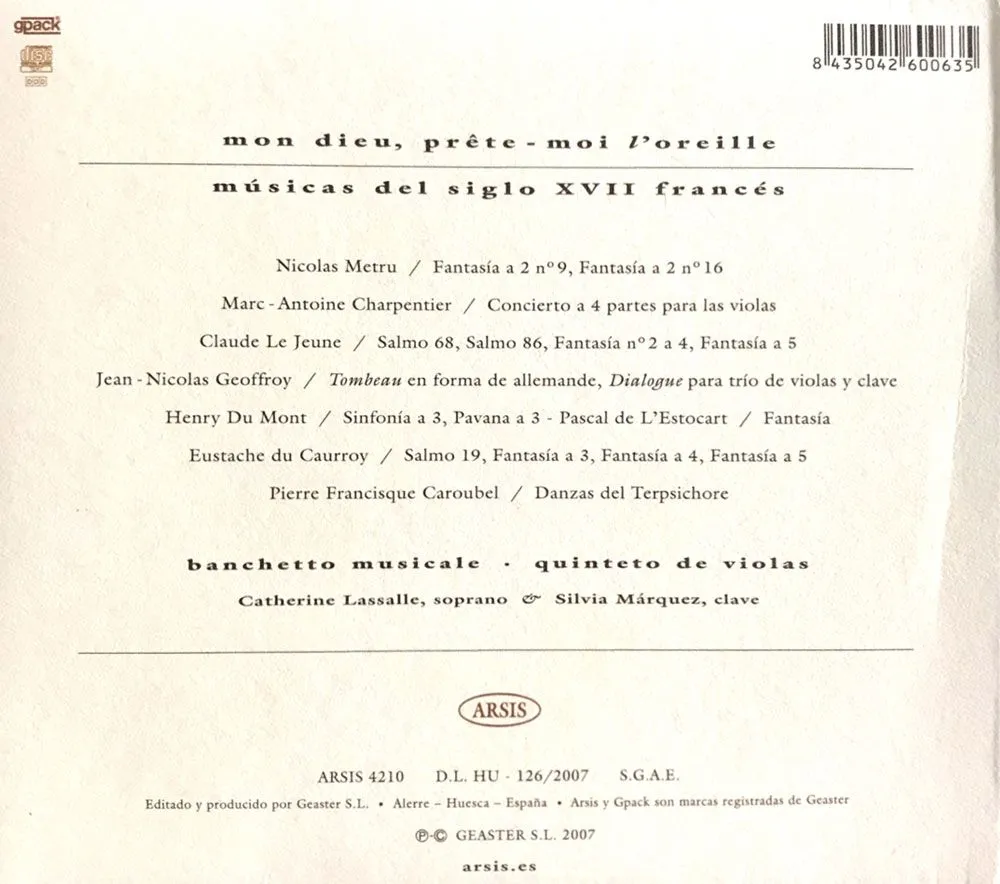
BANCHETTO MUSICALE, PERE ROS, CATHERINE LASSALLE | SILVIA MÁRQUEZ CHULILLA, harpsichord
ARSIS 4210 2007 | HU 126/2007
Not until Henry of Bourbon, King of Navarre, became Henry IV, King of France (1589), could the country enjoy the long-awaited peace, with the promulgation of the Edict of Nantes (1598) and the freedom of worship granted to the Huguenots. A period of extraordinary artistic expansion began for France, with two confessions on equal terms. Composers sympathetic to the Reformation, such as Claude Le Jeune and Eustache du Caurroy, rose to positions of importance.
Psalms, dialogues, fantasias and tombeaux make up the present reading of the fruitful dialogue between two Christian confessions that took place in France during the seventeenth century, with a prominent role for the family of viols (da gamba).
01. Claude Le Jeune Salmo 86 "Mon Dieu, prête-moi l’oreille"
02. Henry Du Mont Sinfonía a 3
03. Claude Le Jeune Fantasía n.º 2 a 4
04. Eustache du Caurroy Fantasía a 4 sobre "Ave maris stella"
05. Nicolas Metru Fantasía a 2 n.º 16
06. Eustache du Caurroy Salmo 19 "Les cieux en chacun lieu". Fantasía a 3
07. Jean-Nicolas Geoffroy Tombeau en forma de allemande
08. Pierre Francisque Caroubel Danzas del "Terpsichore": Passamezzo - Gallarda - Courante - Volta
09. Claude Le Jeune Fantasía a 5 sobre "Benedicta es caelorum regina"
10. Nicolas Metru Fantasía a 2 nº9
11. Claude Le Jeune Salmo 68 "Que Dieu se montre seulement" | Pascal de L’ Estocart Fantasía
12. Henry Du Mont Pavana a 3
13. Eustache du Caurroy Fantasía a 5 sobre "la sol fa re mi"
14. Marc-Antoine Charpentier Concierto a 4 partes para las violas
15. Eustache du Caurroy Fantasía a 4 sobre "Salve regina"
16. Jean-Nicolas Geoffroy "Dialogue" para trío de violas y clave
"The viola da gamba consort Banchetto musicale is made up of Spanish musicians who play this instrument, both as concert performers and as teachers (RCSM de Madrid, L'Escola L'Arc de Barcelona and Academia das Artes, Brion, Galicia). Although the group's usual repertoire dates back to the sixteenth and seventeenth centuries, they use original instruments from the seventeenth and eighteenth centuries in their concerts and recordings."
France was receptive to the Protestant Reformation. In 1559 the first Calvinist synod took place in Paris, accepting the confessio gallicana, drawn up by John Calvin. During his exile in Strasbourg (1539), and in Geneva, where he lived until his death (1564), he worked on the psalter for the use of the Huguenot faithful. The texts of the psalms were adapted to French metre by Clément Marot, Théodore de Bèze and Calvin himself. Most of the melodies were written by Louis Bourgeoys, while others came from the corpus of secular songs, both French and foreign.
In the same year as the synod, Henry II Valois died, a victim of his own arrogance, leaving a kingdom divided by the continual skirmishes between the supporters of the Counter-Reformation, led by the Guises, Dukes of Lorraine, and the Huguenots, protected by some members of the aristocracy (the Princes of Condé and Anthony of Bourbon, King of Navarre, among others). The sons of Henry II would likewise die in tragic circumstances after lashing out blindly against that part of the population inclined to embrace the reforming movement. Nevertheless, Catherine de Medici, their mother, always took care that they were not swept towards the Counter-Reformation cause.
Not until Henry of Bourbon, King of Navarre, became Henry IV, King of France (1589), could the country enjoy the long-awaited peace, with the promulgation of the Edict of Nantes (1598) and the freedom of worship granted to the Huguenots. A period of extraordinary artistic expansion began for France, with the two confessions on equal terms. Composers sympathetic to the Reformation, such as Claude Le Jeune and Eustache du Caurroy, rose to positions of importance.
The former, an active member of the Académie de Poésie, was appointed chamber composer to the king and, following in the footsteps of Philippe Jambe de Fer and Claude Goudimel, set Calvin's psalter in polyphony. His six-voice version of Psalm 86, Mon Dieu, prête-moi l’oreille (no. 1), opens the present reading of some significant examples of the fruitful dialogue between two Christian confessions that took place in France during the seventeenth century, with a prominent role for the family of viols (da gamba).
Two posthumously published fantasias, one for four voices on a simple motif in the first mode (no. 3) and the other for five, based on a Gregorian melisma in the seventh mode, recalling the six-voice motet that Josquin des Prés had written a century earlier on the same melisma (no. 9), together with the four-voice version of Psalm 68 “Que Dieu se montre seulement” (to the melody of the chorale “O Mensch bewein dein Sünde groß”), complete Le Jeune's contribution. Another version of the same psalm by Pascal de l’Estocart, a musician from Calvin's own region who managed to keep on good terms with both sides, is included as no. 11.
Eustache du Caurroy, appointed sous-maître and chamber composer to the King in 1595, enjoyed enormous respect from his contemporaries and successors. The fantasias on Gregorian chants (of Catholic origin) Salve regina (no. 15) and Ave maris stella (no. 4), both for four voices, as well as one for five voices on la, sol, fa, re, mi (no. 13, evoking a mass of the same title by Josquin des Prés based on a melisma from the Kyrie “Cunctipotens genitor Deus”), sit alongside others in his output on melodies from the Huguenot psalter, such as that of Psalm 19, “Les cieux en chacun lieu” (no. 6).
The horrors of the night of Saint Bartholomew (1572), when the soldiers of Charles IX put the Protestant population to the sword, were now far behind. The monarch died a few years later, without managing to free himself of such a heavy burden, and his brother Henry III was assassinated by a supposed Catholic friar in 1589. Even Henry IV, under whose reign prospects of peace and prosperity were opening up, was stabbed by a fanatic in 1610.
Shortly before the second regicide, Pierre Francisque Caroubel, violinist of the king's chamber, travelled to the Court of Brunswick (Germany), taking with him the dance compositions he used to perform at the French Court. The Terpsichore, a collection of music gathered and published in 1612 by Michael Praetorius, contains 82 of these compositions (no. 8).
During the regency of Marie de Medici (widow of Henry IV and mother of Louis XIII), music flourished formidably. It was said that the queen took lute lessons from Ennemond Gautier, and that Cardinal Richelieu, unwilling to be outdone by his sovereign, tried unsuccessfully to emulate her.
The music masters Nicolás Metru (said to have been the teacher of Jean Baptiste Lully - nos. 5 and 10 -) and the Belgian Henry du Mont, composer to the chapel and the chamber from 1672 and harpsichordist to the queen (nos. 2 and 12), were able to develop their new musical forms thanks to the active organisation of the music chapels, the choir schools, the chamber of the Court and the great new fashion for opera (in 1647 an Orfeo by Luigi Rossi, expressly commissioned by Cardinal Marenzio, was premiered in Paris).
Under Louis XIV music reached an unrivalled peak. Among the host of composers, Marc-Antoine Charpentier (who enjoyed the support of a descendant of those Guises who had so opposed Henry IV, by arms and by diplomacy) and, to a lesser extent, Jean-Nicolas Geoffroy (organist in Paris and Perpignan) composed tirelessly for the great liturgies of the Court and the Church.
The latter left a beautiful testimony of a form much prized in that period, the tombeaux, musical epitaphs dedicated to some figure, although they might not explicitly bear the name of a dedicatee (as is the case with piece no. 7, written for harpsichord and evoking the tolling of the death knell in the passage entitled carillon). Almost another epitaph, but this time for the dying world of the family of viols (da gamba), is Marc Antoine Charpentier's exquisite suite entitled Concert a quatre parties pour les violes (no. 14), written a few years before Louis XIV undid the path trodden by his grandfather, when in 1685 the Edict of Nantes was revoked, after which Huguenot places of worship were demolished, liturgical gatherings were forbidden and the Catholic baptism of children was imposed, provoking a mass emigration of Huguenots to other host countries. The dialogue pour les violes et le clavessin (no. 16) symbolises, with its continual rhetorical play and its daring harmonies, an invitation to rebuild the bridges of dialogue.
Thanks to the invaluable help provided by Jean-Luc Salique, Lisette Aubert-Millaret, Claire Gautrot-Gobillard and Juan Carlos Asensio, we have been able to gather all the materials necessary for the present anthology of seventeenth-century French music.
Pere Ros
June 2007
Here are the reviews of this album (CD).